Apple is currently putting the finishing touches on a major step forward for the MacBook Pro line, with advanced features no current MacBook can boast of. And the M6 processor is just the icing on the cake. Here’s why you should wait for it.
Yes, the MacBook Pro just got updated with M5 Pro or M5 Max processors making it the fastest Mac ever. But you should think seriously about skipping it. You’ll kick yourself if you have a relatively new model when something far better comes along in a few months.
Wait for the M6 MacBook Pro: Yes or no?
Urging people to wait for the next MacBook is not my usual advice. That’s because there’s always an improved model on the horizon. If you always hold off for the Mac that rumors say will be faster than the current one, you’ll never buy anything.
There are only two exceptions. If Apple is expected to launch a speed-boosted MacBook Pro in just a few weeks, you should wait for it. Except in unusual circumstances, like you accidentally smashed your old one and must have a computer for work or school.
But in spring 2026, we’re looking at the second exception. Reliable sources have leaked details on a MacBook that’ll offer far more than a faster M6 processor. There’s the potential for a significant redesign with features no MacBook Pro has ever included.
Here are four reasons it’s worth waiting for.
1. A touchscreen MacBook Pro!
After resisting the idea for decades, Apple is allegedly going to add a touchscreen to the M6 MacBook Pro. It’s apparently for people who habitually tap their MacBook screen after years of using an iPhone and iPad, not for those who want to merge a MacBook with an iPad to make a “MacPad.”
According to industry insiders, the device will use a “touch-friendly” rather than “touch-first” philosophy, keeping the traditional keyboard and trackpad as primary inputs while offering the display as a supplemental interaction option.
To accommodate this shift, macOS 27 is rumored to include adaptive interface elements that detect finger input and automatically enlarge menu bar icons and buttons to make interacting within a fingertip easier. We can also look forward to gestures like pinch-to-zoom.
Just so there’s no confusion, it’s not considered likely that every M6 MacBook Pro will include a touchscreen. Expect this to be an optional feature — perhaps even part of a new MacBook Ultra line.
2 First OLED MacBook screen
A touchscreen isn’t the only improvement rumored for the M6 MacBook Pro. This could finally be the version upgraded with an OLED display.
Traditional LCD panels rely on backlights, but with OLED screens, each pixel glows individually — which means that can also turn completely off when displaying black. This produces dramatically deeper blacks and far higher contrast ratios, which can make photos, video and interface elements appear more vivid and lifelike.
OLED panels also typically offer wider color gamut coverage and improved color accuracy, benefits that are especially valuable for professional workflows such as photography, video editing and graphic design.
It’s possible that only models with the high-end M6 variants will get an OLED screen. The model with the basic M6 chip may stick with the current type of screen to lower its cost.
3. Slimmer, lighter design
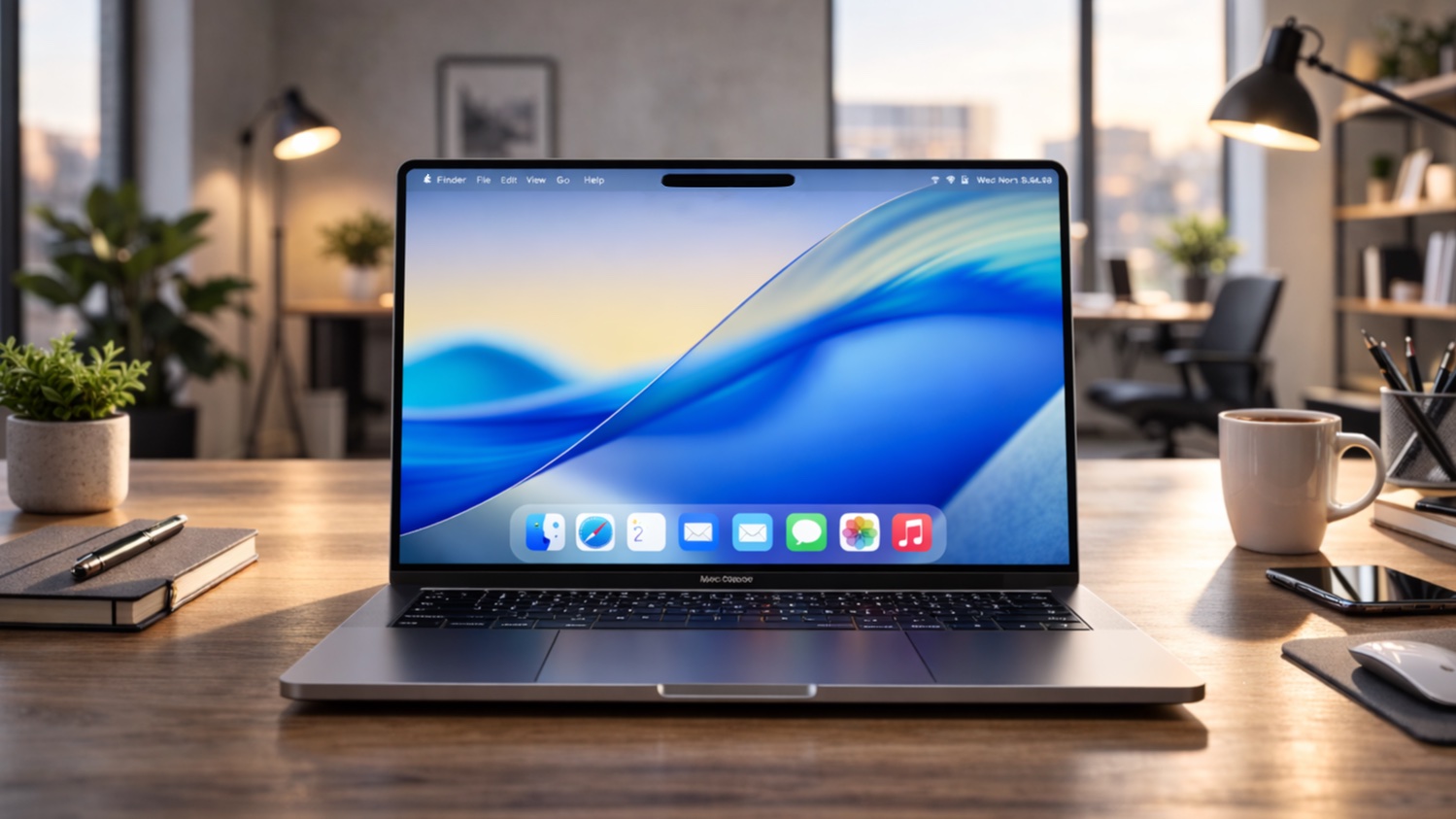
AI image: ChatGPT/Cult of Mac
The OLED display will contribute to another major change in the M6 MacBook Pro: the first redesign since 2021.
Apple is reportedly planning a noticeably slimmer profile, made possible in part by the switch to OLED, which eliminates the need for screen backlights.
And the already lightweight notebook is supposedly getting even lighter than current models.
In addition, the MacBook’s screen notch could be replaced by a Dynamic Island, similar to the one on iPhones.
But don’t worry that Apple will jettison any of the ports. At this time, Apple is expected to keep the SD card reader, MagSafe charger, etc.
Just note that the redesign may only apply to some configurations. The thinner chassis and OLED display could be limited to high-end variants of the MacBook Pro, not the one built around the basic M6 processor.
4. MacBook Pro with M6 Pro and M6 Max
The other hardware changes to the upcoming MacBook Pro are dramatic enough that bringing in a faster processor is a small improvement… in comparison anyway.
Industry experts predict the M6 will be part of the transition to TSMC’s 2-nanometer manufacturing process, which should increase transistor density and power efficiency. That should lead to 15% to 20% better CPU performance while maintaining or improving battery life.
There’ll be a full family of the M6, starting with a base version and going to M6 Pro and M6 Max for high-end MacBook Pro models.
Expect the version of the MBP with the base M6 chip to use the same design and screen as the current macOS notebook. But 14-inch and 16-inch versions with the M6 Pro and M6 Max processors will get an OLED screen and a redesign. The first touchscreen MacBook Pro will likely be available only with the M6 Pro and M6 Max.
Why you shouldn’t wait?
An OLED touchscreen in a redesigned M6 MacBook Pro seems well worth waiting for, but not everyone should put their MacBook Pro purchase on hold until the M6 version is released. My co-worker D. Griffin Jones compiled the reasons you should go ahead and get one of the M5 versions.
The TL;DR is that the new M5 version of the MacBook Pro already offers outstanding performance, especially when configured with the M5 Ultra processor. And you might not be interested in a touchscreen for your MacBook or need an OLED display. Especially as these features are likely to push up the cost of the macOS notebook.
Also, we’re not yet sure of a release date. The next-generation MacBook Pro (and a possible MacBook Ultra) might launch near the end of this year, or shoppers might have to wait until early 2027.

Ed Hardy has been writing full-time about tech for 25 years, and using it for much longer than that. His intro to Apple was a Macintosh SE/30 (which he still has), but now he uses a 13-inch iPad Pro as his primary computer.
That’s because he’s a “tablet first” type of guy. Rather than use a Macbook, he connects a keyboard case to the iPad. And instead of a desktop Mac, he connects his tablet to a 27-inch display and full-size keyboard. (So don’t try to tell him that everyone has to use a Mac to be productive.)
Before coming to Cult of Mac, Ed wrote for NotebookReview, TabletPCReview and Brighthand, as well as other sites.